 Mr. Clothier had lived
in the general area since 1804 or 1805, and between 1812 and 1814 he made the afore
- mentioned transaction with Mr. Boyce, in order to establish a lumber mill. In 1815,
Mr. Clothier began construction of a saw mill with the assistance of his 4 sons,
and they built two dwellings in what is now present - day Kemptville. This mill was
extremely important for the settling of the community, as in order to construct a
crude dwelling, lumber was required - and so, the mill began to facilitate the construction
of dwellings for settlers all over Oxford Township.
Mr. Clothier had lived
in the general area since 1804 or 1805, and between 1812 and 1814 he made the afore
- mentioned transaction with Mr. Boyce, in order to establish a lumber mill. In 1815,
Mr. Clothier began construction of a saw mill with the assistance of his 4 sons,
and they built two dwellings in what is now present - day Kemptville. This mill was
extremely important for the settling of the community, as in order to construct a
crude dwelling, lumber was required - and so, the mill began to facilitate the construction
of dwellings for settlers all over Oxford Township. | History of South Gower |
|
South Gower, the smallest of all Townships in North Grenville, lies in the northeast corner of Grenville. It became incorporated in 1834 and today has a population of over 1300. Many of the people living there today are descendants of those early pioneers.
South Gower Township contains a well-maintained cemetery located just north of Pelton's Corners. It records burials dating as far back as 1817. Earlier markers are believed to exist, but most have fallen victim to weather and age. |
 Many old stone homes
seen throughout the Municipality demonstrate the skill of the sturdy pioneers who
built them. The oldest one is believed to be the Eager House, just east of Heckston,
built between 1817 and 1820. It has the unique feature of a cold cupboard built into
the thick stone foundation wall. One of the modern houses located about one mile
east of Pelton's Corners has combined early pioneering features into it's construction
by having a thatched roof.
Many old stone homes
seen throughout the Municipality demonstrate the skill of the sturdy pioneers who
built them. The oldest one is believed to be the Eager House, just east of Heckston,
built between 1817 and 1820. It has the unique feature of a cold cupboard built into
the thick stone foundation wall. One of the modern houses located about one mile
east of Pelton's Corners has combined early pioneering features into it's construction
by having a thatched roof. | History of Burritt's Rapids |
|
The original settlers of Burritt's Rapids were Stephen Burritt, a United Empire Loyalist, and his brothers Daniel and Edmund. The Burritt family came from an aristocratic Welsh family, pioneering in the state of Vermont.
The Rideau Canal opened on May 29, 1832, and the village prospered with heavy boat traffic between Ottawa and Kingston. Many local residents helped in the construction and rock for the stonework was quarried in this district. The canal was cut in order to bypass the rapids, diverting part of the Rideau. However, there was still enough water rushing over the rapids to keep the mill wheels turning. A cheese factory was built in 1868 by William Kidd, who developed the cheese industry with seven factories between Burritt's Rapids and Ottawa. T.A Kidd established the General Store in 1841, where it remained until 1940. Many businesses, mills and hotels flourished, and by the mid 1870s, pleasure boats began to appear on the canal. By the turn of the 20th century the pioneer lifestyle was disappearing. Gradually, the canal was to become the playground for pleasure boaters and cottagers and the village was destined to become residential with very little commercial life. |
 Stephen Burritt became
the elected representative of the Grenville riding for the 5th Parliament of Upper
Canada. He also opened the first Post Office in the area in 1820. Daniel Burritt
built the first sawmill, producing lumber for the building of new houses, thereby
attracting more settlers to the area.
Stephen Burritt became
the elected representative of the Grenville riding for the 5th Parliament of Upper
Canada. He also opened the first Post Office in the area in 1820. Daniel Burritt
built the first sawmill, producing lumber for the building of new houses, thereby
attracting more settlers to the area.| History of Oxford-on-Rideau |
|
Oxford-On-Rideau Township is situated in the north-eastern part of the United Counties of Leeds and Grenville. In 1791 it was one of the first townships to be surveyed from the Rideau River southward. The beautiful, historic Rideau River forms the northern boundary of the Township. Stephen Burritt, a United Empire Loyalist, became the first settler in the Rideau River in 1793. His son, Edmund Burritt, was the first white child to be born in this area. Stephen Burritt became the elected representative of the Grenville riding for the 5th Parliament of Upper Canada and made four journeys to York (Toronto) between February 1809 and March 1812. He attended sessions "which were held in the winter months when the harvest was over and the granaries and pantries were full. Travel was by horse-drawn sleigh or cutter or cariole". (Excerpt taken from book by Ruth G. Burritt).
The Rideau Canal was opened on May 29, 1832 and the village prospered with the heavy boat-traffic between Ottawa and Kingston. Burritt's Rapids then became an island community with a swing bridge over the Rideau Canal and the stationary bridge over the Rideau River. The family who followed the Burritt's was very similar to their forbears. They were the Kidd family who arrived from Ireland in 1821 and were very prominent in the life of the village and surrounding district. T.A. Kidd was Reeve of Oxford in 1878, son William became a Canon in the Anglican Church, Tom eventually was speaker in the Provincial Legislature while Harold remained in the village where he died in 1974. He was the last of the Kidd family in Burritt's Rapids. Many businesses, mills and hotels flourished and by the mid 1870's pleasure boats began to appear on the canal. By the turn of the 20th century the pioneer style of life was disappearing. Gradually the canal was to become a playground for pleasure boaters and cottagers and the village was destined to become residential with very little commercial life. This is a very pretty village with a set of locks nearby and the surrounding country side provides a rural setting. Many cottages and year-round houses are built along the Rideau River. |
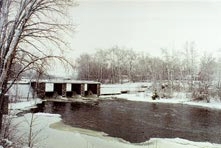 A saw mill was built by Daniel
Burritt at the swift flowing rapids in the river. He was able to produce lumber for
the building of new houses thereby attracting more settlers to the area and the community
became known as Burritt's Rapids. In 1824 the first bridge, a wooden bridge, was
built over the Rideau River joining Marlborough Township to Oxford Township and the
village spread.
A saw mill was built by Daniel
Burritt at the swift flowing rapids in the river. He was able to produce lumber for
the building of new houses thereby attracting more settlers to the area and the community
became known as Burritt's Rapids. In 1824 the first bridge, a wooden bridge, was
built over the Rideau River joining Marlborough Township to Oxford Township and the
village spread.top of page